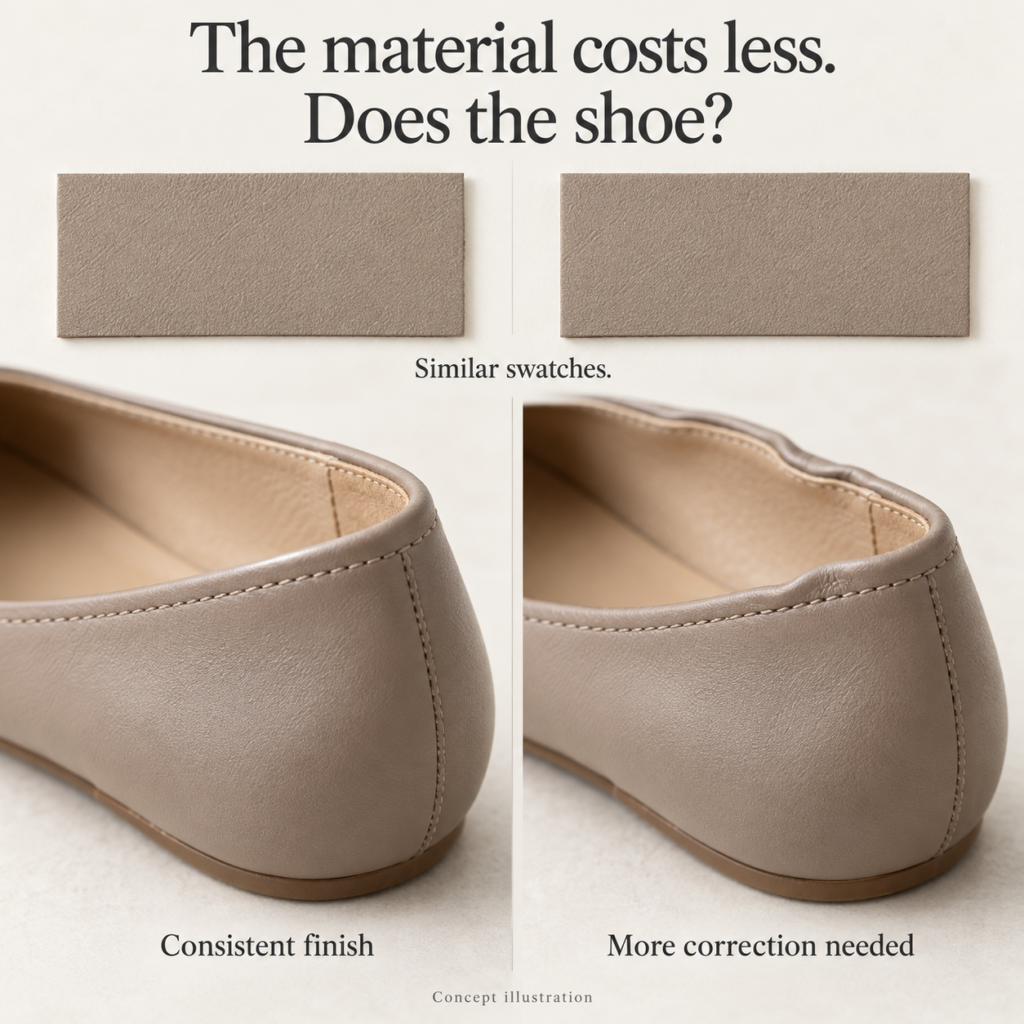
Why a lower-cost upper material does not always lead to a lower-cost finished shoe.
“Can we use this material instead? It looks almost the same, and the price is lower.”
That is a proposal worth considering. Buyers have target costs, and finding suitable alternatives is part of footwear development. But a saving on the material quotation is only the beginning. The next question is what it takes to turn that material into the shoe the buyer approved.
Similar swatches, different production results
We’ve had this on a casual shoe with a clean, folded topline. The original material and a lower-cost alternative looked identical on the swatch card. The difference only became clear during folding and stitching.
One held a clean edge consistently. The alternative needed more adjustment to avoid a wavy topline. Operators slowed down, some uppers needed reworking, and others could not be used.
The material price had fallen. The work needed to produce an acceptable shoe had increased.
By the time the finished pair reached inspection, how much of the saving was still there?
This is why material substitution needs both product and production judgment. Appearance on a swatch card is one part of the comparison. How the material behaves in the intended construction can change the result.
A good sample is the starting point
A carefully finished sample can show what is possible. A production trial helps reveal what it takes to repeat it.
That distinction matters when comparing materials. A sample may achieve the required finish with extra care and repeated adjustment. Before confirming the alternative, the team needs to understand whether that finish can be achieved consistently across an order—and how much correction it requires.
For a folded-topline style, the comparison should establish whether the alternative can hold the approved edge, work with the intended folding and stitching process, and deliver an acceptable result without excessive rework or rejected uppers.
A lower quotation becomes useful to the buyer when it can support a reliable order at the agreed quality.
When a material substitution becomes a product change
Sometimes, a lower-cost material is workable with a construction adjustment. Sometimes, the saving depends on accepting a different finish.
Either can be a reasonable option, provided the buyer understands and approves the change.
If the topline needs a different treatment, the revised product needs reviewing. If a slightly different finish is acceptable, that should be agreed before production. These decisions affect what the buyer will receive.
Without that review, a material substitution can quietly become a product change—or a production problem that appears after the price has already been agreed.
What a useful cost proposal should explain
The strongest cost proposal gives the buyer a clear comparison: where the saving comes from, what needs validating, and what trade-offs they would be accepting.
That means considering the material price alongside its effect on production time, rework, rejected components and the approved finish. Where a construction adjustment is needed, it should be included in the review.
A lower-cost material can be a good choice. The value lies in establishing whether it remains a good choice once it becomes a finished shoe.
Considering an alternative material for a style in development? At LENO, we can help you work through the product and production trade-offs before confirming the change.
Discuss a material alternative with LENO →
START A CONVERSATION
Working on a women’s footwear development project?
Share your reference, target market, product category, and main development concern. We can help identify the practical next step before another sample round.
Discuss Your Project